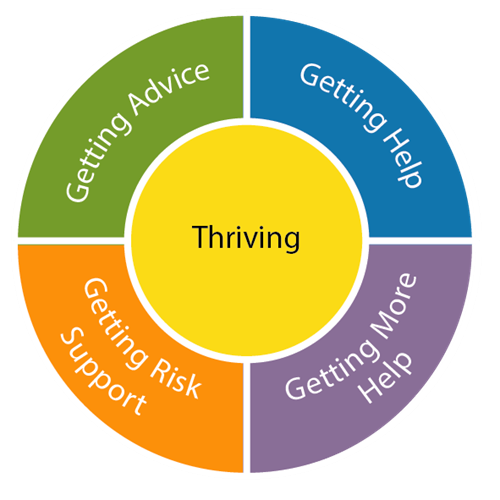
The Thrive model is a national model for children and young people's mental health, which uses a needs-based approach - categorising mental health needs into five groups:
How are local services grouped under the THRIVE model?
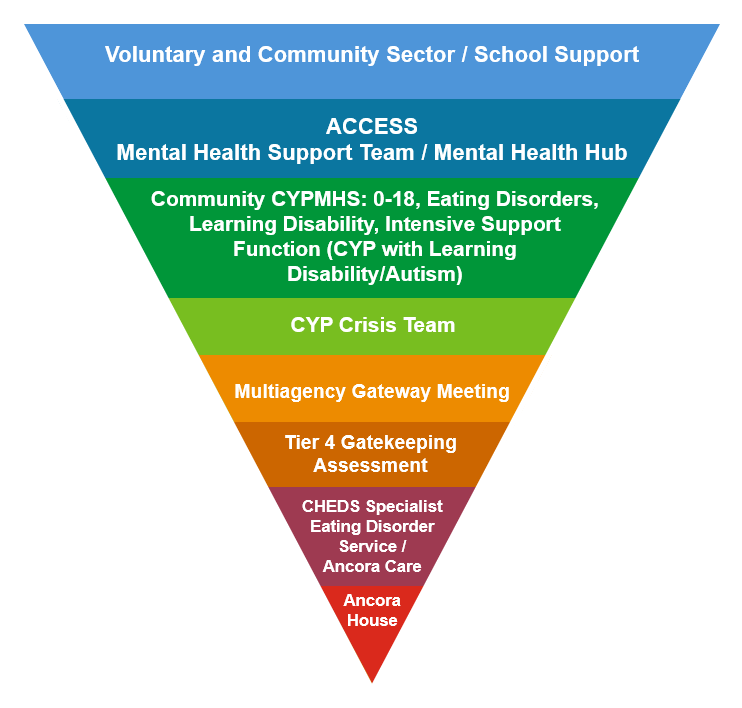
We use the THRIVE model to group services available to support children and young people with their mental health and wellbeing. Some services cover more than one area of THRIVE - you can view the services and the type of support you might receive under each area of the THRIVE model below.
Thriving / getting advice
This may include:
School and community counselling (including online support)
Community groups and voluntary sector support
Online advice and information (for example, the MyMind website)
Local authority early help services
Getting advice / getting help
This may include:
Mental Health Support Teams in schools
Participation opportunities, communication support, and the MyMind website
Outreach to schools and other organisations
Brief, goal-focused interventions for mild to moderate needs — short-term support that helps young people set goals, develop practical strategies, and manage difficulties before they become more serious
Getting help / getting more help
This may include:
Children and Young People’s Mental Health Services (CYPMHS) for ages 0–18, including support for mental health, eating disorders, learning disabilities, autism, neurodevelopmental conditions and youth justice.
Biopsychosocial assessment and formulation — a way of looking at all aspects of a young person’s life (their health, emotions, and social world) to understand what’s going on and how best to help.
Goal-focused interventions for moderate to severe needs — working with a young person to set clear goals and using therapies or support to address their difficulties in a structured way.
Specialist therapies, such as EMDR (eye movement desensitisation and reprocessing), CBT (cognitive behavioural therapy), DBT (dialectical behaviour therapy), medication or psychotherapy.
Specialist group support.
Getting more help
This may include:
Intensive support for children and young people with a learning disability and/or autism
Support to prevent admission to hospital or out-of-area placements
Getting risk support
This may include:
Urgent support when a child or young person is experiencing a mental health crisis
The all-age, 24/7 mental health crisis line (accessed via NHS 111)
Crisis resolution or brief intervention (up to two weeks)
Intensive home treatment (up to twelve weeks)
Specialist services - Tier 4
Beyond the THRIVE model, there are also a number of highly-specialist services available for young people with more severe, complex or persistent mental health problems - you may hear these referred to as Tier 4 services.